

Museum Data Ethics: Why Do Museum Collections Databases Preserve Objects but Erase People?

Updated: Feb 16
!
Trigger warning
Please read before continuing
This post discusses death, human remains, racism, oppression, and the desecration of bodies and cultures within museum and colonial contexts. These topics are addressed critically and with care, but may still be distressing for some readers. Please take your time, step away if needed, and engage with this piece in the way that feels safest for you.
Introduction
After attending the talk: "Skulls, Skin and Names: The Ethics of Managing Heritage Collections Data Online" by Dr Rebecca Kahn, I was inspired to write the LinkedIn post below.
At the time, I wrote from instinct, trying to articulate why the session had unsettled me so deeply, even though I didn’t yet have the language to fully explain it. It left me with questions like:
What do museums choose to remember?
What is society quietly allowed to forget?
In the months since, that short reflection has resurfaced again and again in my thinking, my work, and my conversations with museum professionals. Each time I’ve returned to it, the same questions have followed: about data, dignity, and the quiet ways museum systems continue to strip people of their humanity. The more I sit with it, the more it feels like an unspoken truth embedded deep within museum practice.
Museums pride themselves on knowledge, care, and preservation. We catalogue meticulously. We record provenance, acquisition dates, collectors’ names, and institutional movements with astonishing precision. Yet again and again, when we look closely at collections, particularly those shaped by colonialism, something vital is missing.
This blog post is about returning to that earlier reflection with more distance and clarity. It’s not about one talk or one platform, but about a structural issue that continues to shape how museums collect, describe, digitise, and share their holdings. Beneath the language of metadata, schemas, and digitisation lies a much more uncomfortable question:
What happens when museum systems choose to preserve the details of objects, but fail to preserve the humanity of the people behind them?
Note for the reader:
You’ll see some terms in bold with an asterisk* throughout this post. I’ve added short definitions at the end for terms that can be confusing or are used in different ways.
Museums as data machines
Museums are data-driven institutions at their core. Long before digitisation, museums were already generating vast quantities of information: handwritten accession books, ledgers, index cards, correspondence, field notes, and photographs. These records were shaped by individual hands, disciplinary norms, and institutional priorities. They were inconsistent, messy, and deeply human, but digitisation promised order.
Standardised fields. Controlled vocabularies. Interoperability. The ability to connect collections across departments and institutions at an unprecedented scale. Aggregated platforms such as Europeana or Museum Data Service were developed to make millions of records searchable, reusable, and accessible online. But these services cost more than money.
To function at scale, digital systems rely on simplification; Context is compressed, nuance is lost, and biographies become optional. What remains is what fits neatly into a Database schema* and what has historically been deemed important enough to record.
That importance has rarely centred the lives of the people from whom collections were taken.
This is where openness becomes ethically complicated. Open access, open data, and open licences have undoubtedly expanded research and public engagement, but when applied without ethical frameworks, they can also cause harm, particularly for culturally sensitive materials and human remains. In physical museum spaces, clear guidance governs care, display, and restraint. In digital spaces, those protections often disappear. There are a few shared standards for managing digital surrogates, applying cultural sensitivity warnings, or restricting access where harm is likely.
Just because something can be shared does not mean it should be. Digital collections are not neutral containers; they are ethical spaces. And when efficiency and scale are prioritised over care, the result is a system that remembers collectors in extraordinary detail, while allowing the humanity of the collected to quietly slip out of view.
Museum Data Ethics in Schemas, Classification, and Power
At the heart of this issue lies a deceptively philosophical question:
How do we classify the world?
Schemas and metadata* standards are often presented as neutral tools, but they are anything but. They encode decisions about what matters, what is visible, and what is considered authoritative knowledge.

Traditional museum schemas prioritise:
Object number
Other numbers: Entry no., Accession no., MDA code*,
Acquisition and accession: Owner/donor/seller, bought/donated, Valuation (Monetary value for insurance and/or accounting), Accession number, date,
Condition: of the object and accompanying notes of any conservation conducted
Collection: either Museum, specific department e.g. ethnographic
Object name (s): Museum staff create this from a description of its form, function or object type.
Number of objects: particularly if it is a group of many objects together e.g. 5
Current Location: in the museum, exhibit (on display), box number or who it is loaned to.
Brief description: this could include dimensions, weight, visual description, historical/scientific context, the providence, acquisition information (Owner/donor/seller, bought/donated, Valuation (Monetary value for insurance and/or accounting), or/accession date. This will be dependent on the collections policy of the institution.
It leaves little room or priority to record associated:
Violence and coercion
Spiritual meaning
Emotional resonance
Community memory
Ongoing cultural significance
When culturally sensitive materials are forced into these frameworks, their meaning is flattened. The human spirit is treated as supplementary, if it appears at all.
Reworking this isn’t as simple as adding new fields. It requires a fundamental shift in how authority is understood and a willingness to let communities shape how their histories are described, accessed, and governed (check out my AI ethics blog post to understand the contemporary knock-on effects).
People are reduced to objects in museum collections
One of the most unsettling realities of working in museums is how people become 'objects' the moment they are accessioned into a collection. Human remains are catalogued, stored, digitised, and described using the same systems designed for ceramics, textiles, or fossils. In our databases, our ancestors are reduced to accession numbers, material types, and classifications. This isn't just a technical process; it is an ethical, cultural, and linguistic one because our choices of practices and words matter! The moment when our professional practice makes a person become an “object”, we bureaucratically strip away their humanity.
This 'logic' is not only embedded in our collections databases but reinforced through government policy. The UK’s current policy, 'Guidance for the Care of Human Remains in Museums', hasn't been updated in over 20 years, and there has been no indication of this being addressed any time soon (a topic I have discussed on LinkedIn). It frames “respectful treatment” largely through a Christian lens, with no equivalent recognition of other belief systems, spiritual traditions, or non-religious worldviews. When combined with legislation (Human Tissue Act 2004) that removes consent requirements for remains over 100 years old, this creates a hierarchy of dignity in death: some bodies are protected, while others are rendered available for retention, display, or use without consultation, consent, or transparency; something highlighted in the Laying our Ancestors to Rest Report by the All-Party Parliamentary Group Afrikan Reparations.
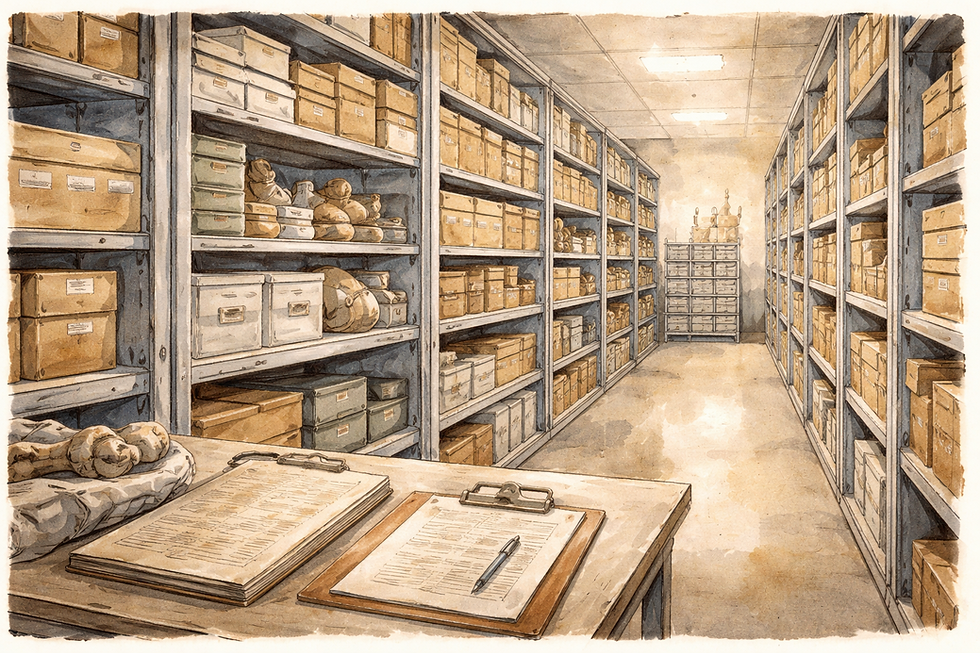
This image is here to illustrate how dehumanising collection's databases can be. It is only here to highlight the lack of care in how people are categorised and displayed within our collections, both online and behind the scenes.
This raises serious human rights concerns. While international law has primarily focused on the rights of the living, human dignity does not end at death. The rights of families, descendants, and communities to equality, non-discrimination, cultural respect, privacy, and dignity are protected under the Universal Declaration of Human Rights. Its principles become undermined (particularly articles 2, 5, 7, 12, 27.2) when certain belief systems are privileged over others, or when human remains are treated as neutral material rather than as people who once lived. This issue has been recently discussed by the United Nations (2024), with them concluding that respecting the dead is inseparable from respecting the human rights of the living. This includes the right to mourn, to truth, and to cultural and spiritual integrity.
"This is a fundamental right of families: a right to know what happened to their loved one, disappeared or deceased. And related to this is the right to the truth, to know specifically what happened and linked to this, the right to justice, to life and to reparation." - Morris Tidball-Binz (2024) United Nations Special Rapporteur on extrajudicial, summary or arbitrary executions
In many colonially acquired collections, records tell us exactly who collected an item, when, and a bit about their biography, particularly if they contributed to a significant proportion of the museum's collection (whether it was donated to or bought by the institution). We know the names of aristocracy, officers, doctors, explorers, and scientists. We know the routes they travelled and the institutions they served.
But the people whose bodies, bones, or skin were desecrated and taken by collectors?
No names,
No dignity,
and their final words... Silenced.
This erasure isn’t accidental; it was systematically designed this way. It reflects the values of the institutions and the curators that created these records and collections in the first place; these systems are rooted in oppression, white supremacy*, and scientific racism*. Unfortunately, digitisation has only reinforced this because we didn't prioritise decolonisation of our institutions, professional practices, data, or selves first.
Putting our humanity back into our museum data systems
We can’t undo how these collections were formed. But we can choose how we care for them now and for the future. That means:
Questioning scale-driven digitisation
Treating databases as ethical spaces, not just technical ones
Slowing down when harm outweighs benefit
Centring dignity, consent, and context in collections work
It also means recognising that humanity shouldn't disappear when something is digitised. A digital surrogate is still connected to a real person, someone who lived, loved, believed, and belonged. If museums claim to be spaces for preserving culture, community centres, and care, then that responsibility must extend beyond the gallery and into the database.
Another question that refuses to go away is ownership. If communities are invited to contribute knowledge, interpretation, and context to collection records:
Who owns that data?
Who controls access?
Who decides how it can be used?
Without care, even well-intentioned participatory projects risk repeating extractive practices. This results in the gathering of community knowledge being absorbed into institutional systems and governed by their rules.
True equity* requires more than access; it requires shared authority, data sovereignty, and a willingness to accept limits. Maybe not everything needs to be open to everyone, all of the time. Sometimes care and dignity can look like restriction or refusal; either way, it is something that must be decided in a socially engaged way, with collaboration and meaningful redistribution of power, that gives greater decision-making abilities in the hands of the communities of origin.
Conclusion: Are we willing to change what we know is broken?
Museums didn’t lose humanity by accident; it was designed out through practices that prioritised authority, ownership, and efficiency over people. Digitisation hasn’t resolved this imbalance; it is actually accelerating it. These systems were built by people, so we have the opportunity to rebuild differently. It is now impossible for me to treat the collection of data as a purely technical concern. Going forward, I am committed to exploring alternative models of data collection that centre care, context, and community authority, while continuing to interrogate the ethics of open access, ownership, and visibility; particularly where openness conflicts with dignity and consent. For us to do better, we will require slower, more intentional approaches with a willingness to sit with discomfort in order to prioritise humanity over efficiency.
If this post resonated with you, please share it with colleagues and institutions grappling with similar questions. These conversations only move forward when we have them collectively. And if you’re a museum or heritage organisation looking to rethink collections data, digitisation, or ethical practice, I offer consultancy grounded in care, critical reflection, and practical change.
Get in touch if you’d like to continue the conversation because rehumanising our collections isn’t an abstract ideal; it’s our responsibility.
Your Call to Action - What Now?
If you work with collections, data, digitisation, or interpretation, consider this an invitation to be apart of a movement for impactful change:
Reflect on and share this post.
Pause before the next record is published.
Question what your database schema is.
- who benefits and who is harmed by it?
Ethical practice doesn’t have to be perfect, but it does have to be intentional.
A database schema defines how data is organised within a relational database; this is inclusive of logical constraints such as table names, fields, data types and the relationships between these entities.
It is the data about the data that acts as the system's ability to search, organise, and categorise, and use data, e.g. author, creation date, file size.
The Collection Trust's 5-letter issued code that is unique to the museum or museum service acts as a prefix to accession numbers.
White supremacy describes the systems and structures that sustain white dominance by positioning whiteness as the norm. These systems are upheld through everyday attitudes, institutional practices, and policies (often without explicit intent). Upholding white supremacy does not require extremist beliefs; it can occur through ordinary, unexamined participation in existing systems.
Scientific racism refers to the misuse of scientific methods and ideas to justify racial hierarchy and discrimination. Emerging in the nineteenth century, it drew on Enlightenment thinking around classification and rationality to categorise human difference in ways that falsely positioned whiteness as superior and civilisation as exclusively white.
For the context of this post, I am referring to Social Equity. This refers to fair treatment that recognises and addresses unequal starting points shaped by social, economic, and structural disadvantage. Rather than treating everyone the same, it focuses on reducing exclusion and inequality by centring dignity, access, and the inclusion of diverse lived experiences (particularly those of communities who have been historically marginalised).
Links and References:
Kahn, R. (2025) Skulls, Skin and Names: The Ethics of Managing Heritage Collections Data Online. Talk delivered on 22 March 2025.
Anti Racist Cumbria -Anti-racist guide to terminology. Available at: https://antiracistcumbria.org/anti-racist-guide-to-terminology/
Collections Trust -Cataloguing: suggested procedure. Available at: https://collectionstrust.org.uk/resource/cataloguing-suggested-procedure/
Collections Trust - Documentation policy. Available at: https://collectionstrust.org.uk/accreditation/managing-collections/collections-information/documentation-policy/
Collections Trust - MDA codes. Available at: https://collectionstrust.org.uk/resource/mda-codes/
Department for Culture, Media and Sport (2005) Guidance for the Care of Human Remains in Museums. London: DCMS. Available at: https://www.gov.uk/government/publications/guidance-for-the-care-of-human-remains-in-museums
Europeana collections. Available at: https://www.europeana.eu/en
IBM-What is a database schema? Available at: https://www.ibm.com/think/topics/database-schema
What ethics do I need to consider when using AI? Available at: https://www.muchaduabout.com/post/what-ethics-do-i-need-to-consider-when-using-ai
Museum Data Service. Available at: https://museumdata.uk/
Office of the United Nations High Commissioner for Human Rights (2024). Protecting and respecting the dead makes us human. Available at: https://www.ohchr.org/en/stories/2024/07/protecting-and-respecting-dead-makes-us-human
United Nations (1948) Universal Declaration of Human Rights. Available at: https://www.un.org/en/about-us/universal-declaration-of-human-rights
UNESCO World Heritage Centre -Glossary: Equity. Available at: https://whc.unesco.org/en/glossary/365


